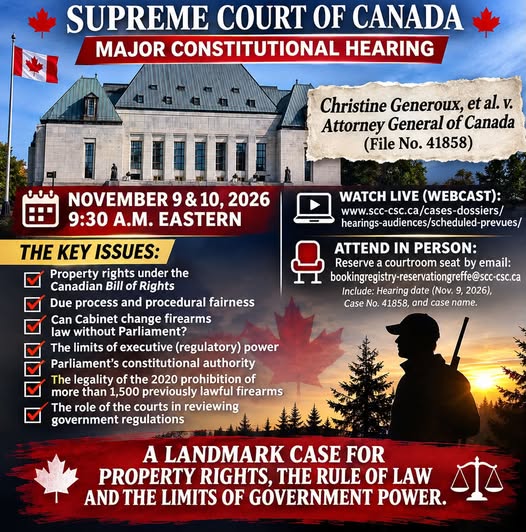
SUPREME COURT OF CANADA — MAJOR CONSTITUTIONAL HEARING
CAN THE FEDERAL GOVERNMENT PROHIBIT LAWFULLY OWNED FIREARMS THROUGH REGULATIONS?
PROPERTY RIGHTS — DUE PROCESS — PARLIAMENTARY AUTHORITY — THE RULE OF LAW — GOVERNMENT ACCOUNTABILITY
The Supreme Court of Canada will hear four related appeals challenging the federal government’s 2020 firearms prohibitions.
LEAD CASE:
Christine Generoux, et al. v. Attorney General of Canada
Supreme Court File No. 41858
The hearings begin Monday, November 9, 2026, at 9:30 a.m. Eastern and continue Tuesday, November 10.
These appeals raise important questions about the limits of executive government power, the authority of Parliament, the rule of law and the legal protections available to Canadians.
THE TEN KEY LEGAL ISSUES
- PROPERTY RIGHTS UNDER THE CANADIAN BILL OF RIGHTS
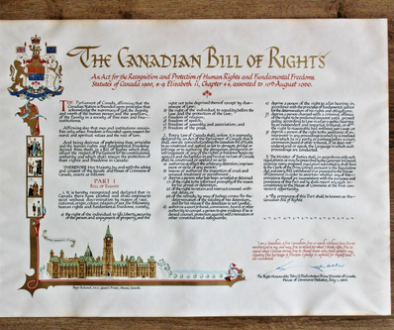
Section 1(a) of the Canadian Bill of Rights recognizes the right to the enjoyment of property and the right not to be deprived of it except by due process of law.
Does the federal government’s prohibition of previously lawful firearms interfere with these protections?
- CAN CABINET CHANGE FIREARMS CLASSIFICATIONS WITHOUT PARLIAMENT PASSING NEW LEGISLATION?
The government relied on regulation-making authority under section 117.15 of the Criminal Code.
The appeals raise questions about the limits of that delegated authority.
- PARLIAMENT’S CONSTITUTIONAL AUTHORITY
Section 91(27) of the Constitution Act, 1867, assigns criminal law jurisdiction to Parliament.
What limits apply when Parliament delegates regulation-making authority to the executive government?
- THE PROHIBITION OF PREVIOUSLY LAWFUL PROPERTY
On May 1, 2020, federal regulations prohibited more than 1,500 models and variants of firearms.
Many had previously been lawfully possessed by licensed Canadians.
The appellants challenge the legality of these regulatory changes.
- DUE PROCESS AND PROCEDURAL FAIRNESS
What legal protections must exist when government regulations substantially restrict the possession and use of previously lawful private property?
- THE LIMITS OF EXECUTIVE POWER
Can delegated regulatory powers be exercised so extensively that they fundamentally change an established legal framework?
Where is the legal boundary between Parliament’s authority and Cabinet’s authority?
- THE ROLE OF THE COURTS
What standard should courts apply when reviewing government regulations made under delegated statutory powers?
These appeals provide the Supreme Court with an opportunity to examine the legal limits of executive regulation-making.
- THE RULE OF LAW — VAGUE AND UNDEFINED TERMS
The rule of law requires laws and regulations to be sufficiently clear that Canadians can understand their legal obligations and determine what conduct is prohibited.
The firearms prohibitions raise concerns about vague classifications, including references to firearm “variants” and descriptions such as “assault-style firearms.”
The term “assault-style firearms” does not have a precise statutory definition, raising questions about how firearms are identified and classified.
Can the government impose serious restrictions on previously lawful property through classifications that are unclear, inconsistently applied or insufficiently defined?
Can Canadians reasonably be expected to comply with prohibitions when the terminology used to describe the affected property is ambiguous?
- CULTURAL DISCRIMINATION AGAINST LAWFUL FIREARMS OWNERS
Firearms ownership has longstanding cultural, recreational and sporting traditions in Canada.
These include hunting, competitive shooting, collecting and the responsible use of firearms by licensed Canadians.
The prohibitions raise concerns about whether lawful firearms owners have been unfairly characterized or subjected to discriminatory treatment because of their participation in these activities.
Government decisions must be based on lawful authority and proper considerations, rather than prejudice against a particular community.
The broader question is whether Canada’s licensed firearms owners have been treated fairly and consistently under the law.
- POLITICAL PERSECUTION AND THE PROTECTION OF LAWFUL CITIZENS
The appeals also raise broader concerns about the treatment of licensed Canadians whose firearms were lawfully acquired and possessed before the 2020 prohibitions.
Questions arise about whether regulatory powers have been used to target a politically unpopular group rather than address demonstrated unlawful conduct.
The rule of law requires government authority to be exercised for lawful purposes, without arbitrariness or improper political considerations.
Can government use its regulatory powers to impose sweeping restrictions on a group of law-abiding citizens because their lawful activities have become politically controversial?
These concerns highlight the importance of judicial oversight when executive decisions substantially affect the property and lawful activities of Canadians.
FOUR APPEALS WILL BE HEARD TOGETHER
41858 — Christine Generoux et al. v. Attorney General of Canada
41859 — Canadian Coalition for Firearm Rights et al. v. Attorney General of Canada
41860 — Michael John Doherty et al. v. Attorney General of Canada
41861 — Jennifer Eichenberg et al. v. Attorney General of Canada
The Attorney General of Canada will respond to the appeals.
Several interveners, including provincial Attorneys General and firearms and civil liberties organizations, will also participate.
WATCH THE SUPREME COURT HEARING LIVE
MONDAY, NOVEMBER 9, 2026
9:30 A.M. EASTERN
The Supreme Court confirms that these appeals will be webcast live.
Access the hearing through the Supreme Court’s official scheduled hearings page:
https://www.scc-csc.ca/cases-dossiers/hearings-audiences/scheduled-prevues/41858-41859-41860-41861/
Find Case No. 41858 and select the webcast when available.
No advance registration is indicated for watching the public webcast.
ATTEND THE HEARING IN PERSON
Members of the public wishing to attend in the courtroom must reserve a seat in advance.
EMAIL TO RESERVE YOUR SEAT:
bookingregistry-reservationgreffe@scc-csc.ca
Include:
Hearing date: November 9, 2026
Case number: 41858
Case name: Christine Generoux et al. v. Attorney General of Canada
Courtroom seating is limited.
SUPREME COURT OF CANADA
West Memorial Building
344 Wellington Street
Ottawa, Ontario
NN, DB